
Culture
Strategy, operating model and technology only create value when behaviour changes.
We help you understand what drives behaviour today to design a system that reinforces the behaviours you need.
There are no quick fixes when it comes to culture. To evolve it in the right direction, we need to design a system that reinforces the desired behaviours. The four steps form a continuous loop: what we learn in step 4 feeds back into step 1, and as behaviours improve, this leads to improved performance.
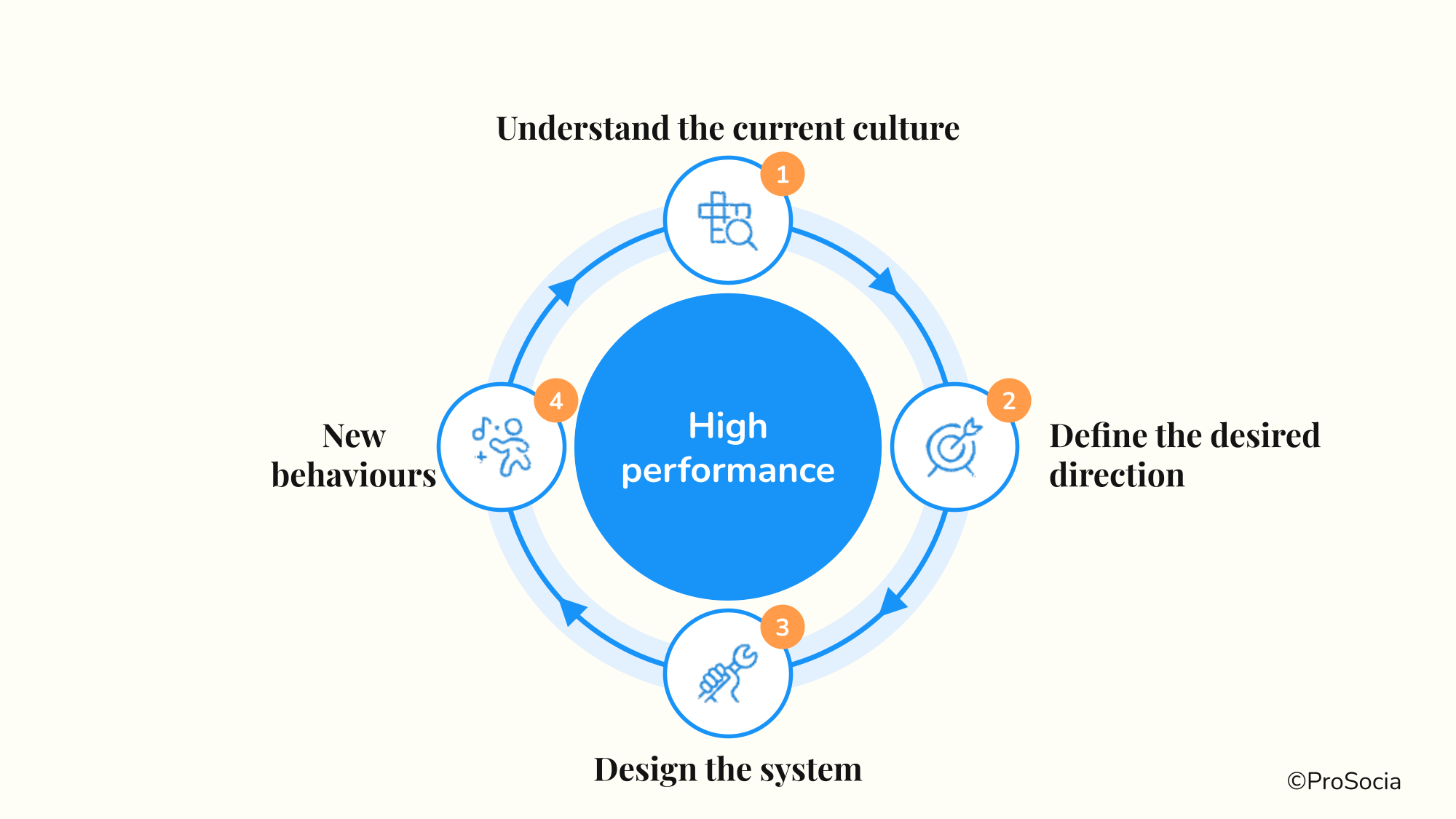
Understand the why behind behaviour
To understand if our current behaviours support our goals, we need to look beyond surface level values and norms and understand the why behind our behaviours and practices.
As the model below illustrates, culture change only occurs when people have a positive shared experience of a new behaviour. Ongoing measurement of culture provides valuable insights into the impact of our efforts, allowing us to continuously inspect and adapt our approach.
Without measuring culture, we are just guessing. We cannot know if our culture is working for us or against us and we certainly cannot improve it.
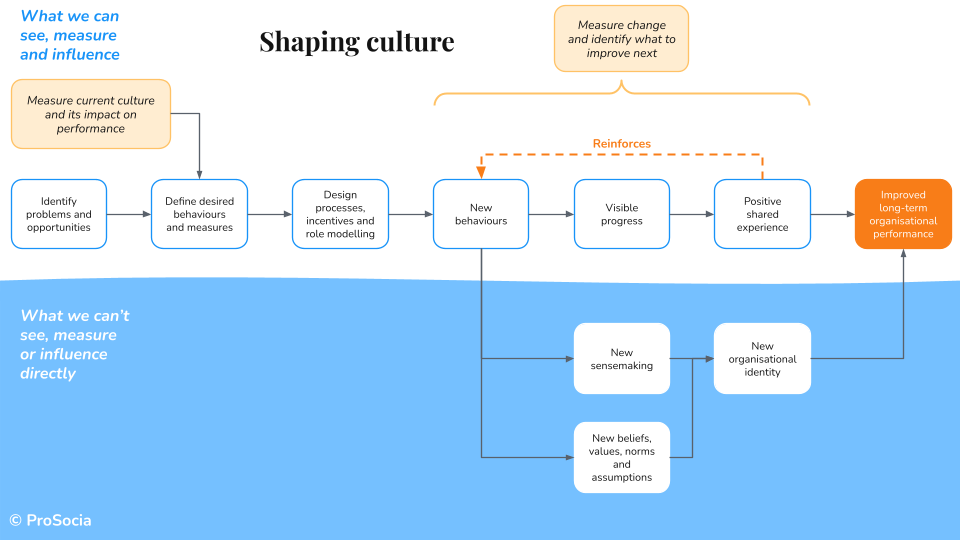
Steps to shape and nurture culture
Understand current behaviours and the reasons behind them
Start with the strategic goals and the structures, metrics, processes and incentives that shape behaviour today.
This is the step most organisations skip because it takes effort. Without understanding why people behave as they do, we can’t change those behaviours.
Questions to ask
- What challenges and opportunities do we have in our organisation?
- Are our current behaviours supporting our strategic goals?
- Why do people behave the way they do?
How
- Observe how teams work.
- Have teams and leaders self-assess their interactions and actions.
- Run anonymous surveys that provide qualitative and quantitative data.
- Interview people about their perceptions and experiences.
- At team level, review insights from retrospectives and similar team reflection sessions, only where teams choose to share them and confidentiality is protected if used outside of teams.
- Use several measures rather than relying on one, so no single metric gets corrupted (see more on risks and mitigations).
Define the desired direction for behaviours
While step 1 makes the current culture visible, this step makes the desired culture tangible. Based on what people shared in step 1, we translate values and aspirations into specific, observable behaviours. This creates a shared understanding of what is expected. These behaviours are a starting point, not a fixed end state. We keep refining them based on what we learn in step 4.
Questions to ask
- Which behaviours are critical to achieving our strategic goals?
- If we solved the problems we identified in step 1, which behaviours would we expect to see?
- Where is there misalignment between our current behaviours and the direction we want?
How
- Describe each behaviour in specific, observable terms so everyone shares the same understanding of what good looks like.
- Define the specific behaviours leaders need to role-model, given their outsized influence on culture.
- Comparing current behaviours with the desired direction shows where the system needs to change first.
Design the system
Establish how to shape, reinforce and support the desired behaviours.
The aim is to build a preventative system. Rather than waiting for the culture to become toxic before we do anything to avoid the cost and effort of dealing with the results of a poorly designed system.
Questions to ask
- Which incentives, role modelling and processes will support those behaviours?
- How will we embed these behaviours in every leader’s, team’s and individual’s goals, development conversations and career progression?
- Which metrics will show whether behaviours are moving in the right direction, and why?
How
- Based on what we’ve learned about why people behave the way they do, we design small experiments: changes we believe will encourage the desired behaviours.
- We then observe and measure how people respond and adjust based on what we learn. Fast feedback loops allow the organisation to learn and adapt continuously.
- Define what to measure, why and how. Pair metrics that show whether behaviours are changing with insights that explain why. Numbers tell us what is happening; conversations, open-ended survey questions and team reflections tell us why. For example, if fewer issues are being raised, is it because problems are being solved or because people no longer feel safe speaking up? The same number can point to opposite actions, and only the why tells us what to change in the system next (read more on measuring culture).
Embed new behaviours: reinforce what works, adapt what doesn’t
When expectations are clear, processes encourage the desired behaviours and people feel supported, they start trying new behaviours. When they see visible progress, they have positive experiences, and when these experiences are consistent, the new behaviours last.
Questions to ask
- What is and isn’t working, and why?
How
- For example, collaboration improves, decisions get easier and people feel safer raising issues because they see them resolved quickly. This visible progress creates positive experiences that reinforce the new behaviours.
- Over time, this leads to improved performance.
- Regular feedback from these metrics flows back into step 1, so the whole cycle keeps evolving based on what works and what doesn’t.