In Brief
The problem: Organisations are racing to adopt AI. However, technology alone delivers no value without a strong cultural foundation. Only 6% of organisations report significant value from AI. They are also the ones investing the most in it. At the same time, many culture efforts remain performative: value statements, engagement surveys and freebies that don’t change how people actually behave.
Why it happens: Culture is how we act, and the system people work in largely shapes that behaviour. Shaping culture therefore starts with the system, and this is where many organisations struggle: they don’t understand why their people behave the way they do, they treat culture as someone else’s job and they keep it too abstract to act on.
The solution: Build culture into the strategy instead of leaving it as a wish list of values. Three principles guide this: understand why people behave the way they do, make culture everyone’s responsibility and make it tangible. A four-step method puts these principles into practice: (1) understand current behaviours; (2) define the behaviours the organisation wants; (3) design the system to support them; and (4) see new behaviours emerge through consistent positive experiences, then reinforce what works and adapt what doesn’t. Rather than doing everything at once, organisations benefit from thinking big, starting small and learning fast.
Moving Past Performative Culture: Principles for Real Change
Organisational culture is finally having its main character moment thanks to AI. As organisations race to adopt AI, they are discovering a fundamental truth: technology alone delivers no value without a strong cultural foundation. Only 6% of organisations report significant value from AI. These organisations also invest the most in it (Dan Tinkoff et al., 2026).
After all, the hardest part of AI isn't technical implementation: it's creating and nurturing the culture necessary for success.
AI opens up unprecedented opportunities for growth, innovation and positive impact. However, it is not a goal in itself; it is a means to achieve our strategic goals faster and more effectively. As such, we can't simply lay AI on top of our existing organisation and expect a Return on Investment (ROI). Instead, the organisation itself needs to evolve. This requires:
A clear AI strategy linked to organisational vision and purpose
An operating model that leverages AI to execute strategy more effectively by supporting rapid decision making and empowering staff with appropriate guardrails
A change management approach that ensures buy-in across the organisation from the outset with a compelling change narrative and effective support and feedback mechanisms.
Culture is the enabler for all of this: it determines whether an organisation can form a good strategy in the first place and whether it can execute. In practice, this means a culture that:
Fosters critical thinking and emotional intelligence
Creates alignment and ensures psychological safety
Makes it easy for people to understand and prioritise the problems to solve
Empowers staff to experiment ethically
Enables effective collaboration
Encourages everyone to continuously learn, improve and adapt.
As such, culture is a crucial indicator of whether AI will deliver real value for organisations, their people and their customers. Yet very few organisations understand how to shape and nurture their culture beyond performative gestures due to:
A lack of understanding of why people behave the way they do.
Not treating culture as a shared responsibility across every role.
Viewing culture as an abstract concept rather than making it tangible.
Without making culture tangible and understanding why people behave the way they do, it is impossible to design a system that successfully evolves the right culture.
Let me define what I mean by culture:
Culture is how we act. It’s our behaviour.
When we view it that way, we can finally see it, understand it and work with it effectively.
While well intentioned, culture change fails when it relies on a generic engagement survey that produces invalid and unactionable data and a detached team treating culture as an isolated project.
This article shares a simple method for intentionally shaping and continuously improving culture. It’s a method we use to help organisations shape their culture, and one that can be put to work immediately. The following sections explain each principle and show how to put them into practice through a practical method that works at both team and organisational level.
Principle 1: Understand Why People Behave the Way They Do
Stop Treating Symptoms, Start Addressing Root Causes
We recently spoke with a company that was grappling with a common challenge: people weren’t following the processes despite clear policies and documentation. Leadership wanted to foster modern, collaborative, ambitious and innovative ways of working. On paper, the policies, processes and values were all there; they just weren’t embedded in daily practice.
This raises a fundamental question that few organisations can answer: Why are our people behaving the way they do?
Understanding this in depth is arguably the most important thing leaders can do to drive meaningful change for their people, their business and their customers.
Like so many well-intentioned organisations, this company was drawn to quick, easy fixes: perfecting policies and processes and implementing new tools. What it skipped was understanding the people who would use them. In other words, they did not first understand the existing culture. Take three common organisational challenges: poor collaboration, siloed knowledge and slow decision-making. They are often treated as root causes but they are usually symptoms of deeper issues. Yet, organisations try to fix them with tools, training and policies without addressing what actually drives these behaviours. As a result, nothing changes and the problems remain.
Gaining a deep understanding of why people behave the way they do is essential to design a system that shapes the behaviours the organisation needs in order to be successful.
Behaviour is largely an output of the system people work in. As Arthur Jones observed: "All organisations are perfectly designed to get the results they get” (cited in David Hanna, 1988, p. 36). In other words, the outcomes a system produces are a direct consequence of its structure, processes and practices, which are themselves shaped by the organisation’s culture. Consequently, if an organisation is not satisfied with its performance, it has to change the system itself rather than blame the individuals within it. As W. Edwards Deming puts it: “A bad system will beat a good person every time” (W. Edwards Deming, 1993, cited in John Hunter, 2015).
It’s Not a People Problem, It’s a Design Problem
A toxic culture is not just one bad actor; it’s a system that tolerates, avoids and ultimately reinforces toxic behaviour. By the time we finally act, the damage is already done.
Any attempt to shift behaviour without understanding why people act as they do is flying blind, regardless of how many new policies, AI tools, value statements or training modules we roll out.
To design a system that shapes the behaviours we want, we need to ask ourselves: how is the system currently incentivising people to behave?
What do our metrics, goals and rewards encourage?
Who makes decisions and how quickly?
Which processes and ways of working make the behaviours we want easy or hard?
What happens when someone raises a problem or makes a mistake?
What do leaders role-model day to day?
These questions also reveal where work gets stuck and why. Whether it’s decisions that stall, processes that get in the way of the right behaviours or problems people are afraid to raise. These are often the places where AI can make the biggest difference, however, only if the underlying causes are addressed. Before implementing any technical solution, organisations therefore need to understand:
Which problems to solve and which carry the highest priority.
The nature of work and how value flows through the organisation.
That might seem obvious, yet many organisations start with the tool and as a result they don’t get the value they hoped for. Once the problems are well understood and prioritised, successful AI adoption depends on the organisation’s ability to uplift internal capabilities, support people through change and shape behaviours.
Principle 2: Make Culture Everyone’s Responsibility
Culture Is Emergent
An organisation is a complex adaptive system; its culture emerges from countless interactions between its people (David Snowden, 2002). Organisations are not "(...) innate entities but webs of human social interaction, which give rise to emergent shared cultural attributes that in turn relate to a specific worldview or mental representation of contextual reality" (Richard Weeks, 2010, p. 49).
Culture doesn’t come from policies, value statements or guidelines. It is shaped every day by how people engage with one another.
Culture evolves continuously through shared learning, sensemaking and experience (Edgar Schein and Peter Schein, 2017; Karl Weick, 1995). Since it is a living system with non-linear dynamics, we cannot predict exact outcomes with certainty. However, by understanding how to influence people’s thinking, we can shape behaviours intentionally. This means we cannot rely on a fixed, top-down plan and expect predictable results. Culture is better shaped through continuous experimentation, learning and adaptation.
Since culture emerges from everyone’s interactions, everyone plays a part in shaping it, which is why it works best as a shared responsibility.
Culture Is Not Someone Else’s Job
In practice, however, we tend to treat culture as if it belongs to HR, the CEO or a few ‘culture people’ on the side. When we approach culture as someone else’s job, we limit the potential of all individuals and teams to take ownership of it. This makes culture change very difficult. Of course, leaders have an outsized influence, which is why defining tangible leadership behaviours is crucial.
To drive lasting cultural change, culture must be embedded into every leader’s, team’s and individual’s daily goals and conversations. Career advancement shouldn’t depend on domain expertise alone, it must also reflect how employees contribute to the desired culture through their daily behaviour. For people leaders, culture is the foundational metric that powers every business outcome: How are their behaviours creating an environment where people can do their best work every day?
However, responsibility is impossible without tangibility.
Once culture is clearly defined and measurable, development conversations and team goals take on a whole new shape. They are grounded in clear, practical cultural expectations that accelerate performance. This is why making culture tangible is the third principle.
Principle 3: Make Culture Tangible
We Can’t Improve a Culture We Can’t See
Since culture often feels abstract and overwhelming, organisations default to what’s easily accessible: freebies (Friday drinks, office decor, snacks, table tennis), tools and technology. These feel like progress, but none of them change how people actually behave. Technology and tools are constrained by culture. Collaboration platforms become means of micromanagement, AI solutions tend to amplify systemic problems rather than fix them and freebies will never be enough by themselves.
The same happens with measurement. Organisations over-index on easily accessible metrics instead of collecting data guided by a sound research design: knowing what to measure, why and how, so it leads to actionable insights (read more about research design and culture metrics).
Get Specific About What Good Looks Like
A culture of strong collaboration allows teams to explore the problem space from every angle before jumping to solutions. Every company wants to improve collaboration but few make it tangible enough to be practical. Instead, they rely on vague terms that invite conflicting interpretations: to one person, it means avoiding conflict; to another, it's just a transactional handoff; to a third, it means co-creating from day one; and to someone else, it means everyone must agree on everything. When these unspoken assumptions collide, friction is inevitable.
That’s why we have to get specific. We need to ask ourselves what our organisation’s culture looks like in practice. How do we know whether the behaviours we want are happening when we aren’t looking? In either case, do we understand why?
If our culture isn’t tangible, we can’t tell whether it’s moving in the right direction, let alone understand why. Without that understanding, we cannot identify how to improve. Once we can see both our current culture and where we want it to be, the gap between them shows us what in the system needs to change to shape the behaviours we want.
How to Shape Culture Intentionally
Start With a Strategy, Not a Wish List
The three principles lay the groundwork. On their own, however, they won’t shape culture. Without a clear strategy and a plan to act on it, even well defined behaviours remain a wish list. Our strategy sets out how to close the gap between where we are now and where we want to be. Our plan turns it into action.
Too often, culture work begins and ends with a wish list: be faster, more collaborative, more innovative, more accountable. These are aspirations, not a plan. Goals alone are not a strategy, they offer statements of desire rather than a plan for how to address the challenges (Richard Rumelt, 2011).
Goals matter, but they don’t explain how to get there. A good strategy provides a diagnosis of the challenge, a guiding policy for addressing it and a set of coherent actions (Rumelt, 2011).
The three principles inform each part. Understanding why people behave the way they do and making culture tangible lead to the right diagnosis. The diagnosis identifies the critical challenge: the misalignment between the behaviours we want and the behaviours we have as well as the problems in the system that cause it such as incentives that reward the wrong behaviours or decisions that stall because people fear being blamed. The guiding policy is the overall approach we choose to close that gap, such as making it safe to experiment, encouraging collaboration across teams or pushing decisions closer to the work. Making culture everyone’s responsibility is a guiding policy in its own right, and it ensures the coherent actions are carried out across the organisation as part of the overall strategy rather than as a side project.
In practice, starting with a strategy means linking culture directly to what the organisation is trying to achieve. We begin with our strategic goals and ask which behaviours are critical to reaching them. We then use the diagnosis to understand what currently helps or hinders those behaviours. From there, shaping those behaviours becomes a deliberate part of the strategy, with clear ownership, success measures and regular reviews. The method below shows how to do this step by step.
A Practical Method for Shaping Culture
There are no quick fixes when it comes to culture. To evolve it in the right direction, we need to design a system that reinforces the desired behaviours. The model below provides a high level overview of a practical, systematic and evidence based approach. Each step both draws on and strengthens the three principles:
Step 1 builds an understanding of why people behave the way they do
Step 2 makes the desired culture tangible
Step 3 embeds shared responsibility by designing everyday systems that support the desired behaviours
In step 4, new behaviours emerge when people have consistent positive experiences. We then reinforce what works and adapt what doesn’t. Steps 3 and 4 form a feedback loop: what we learn feeds back into the system design, so it is continuously refined. As behaviours improve over time, this leads to improved performance.
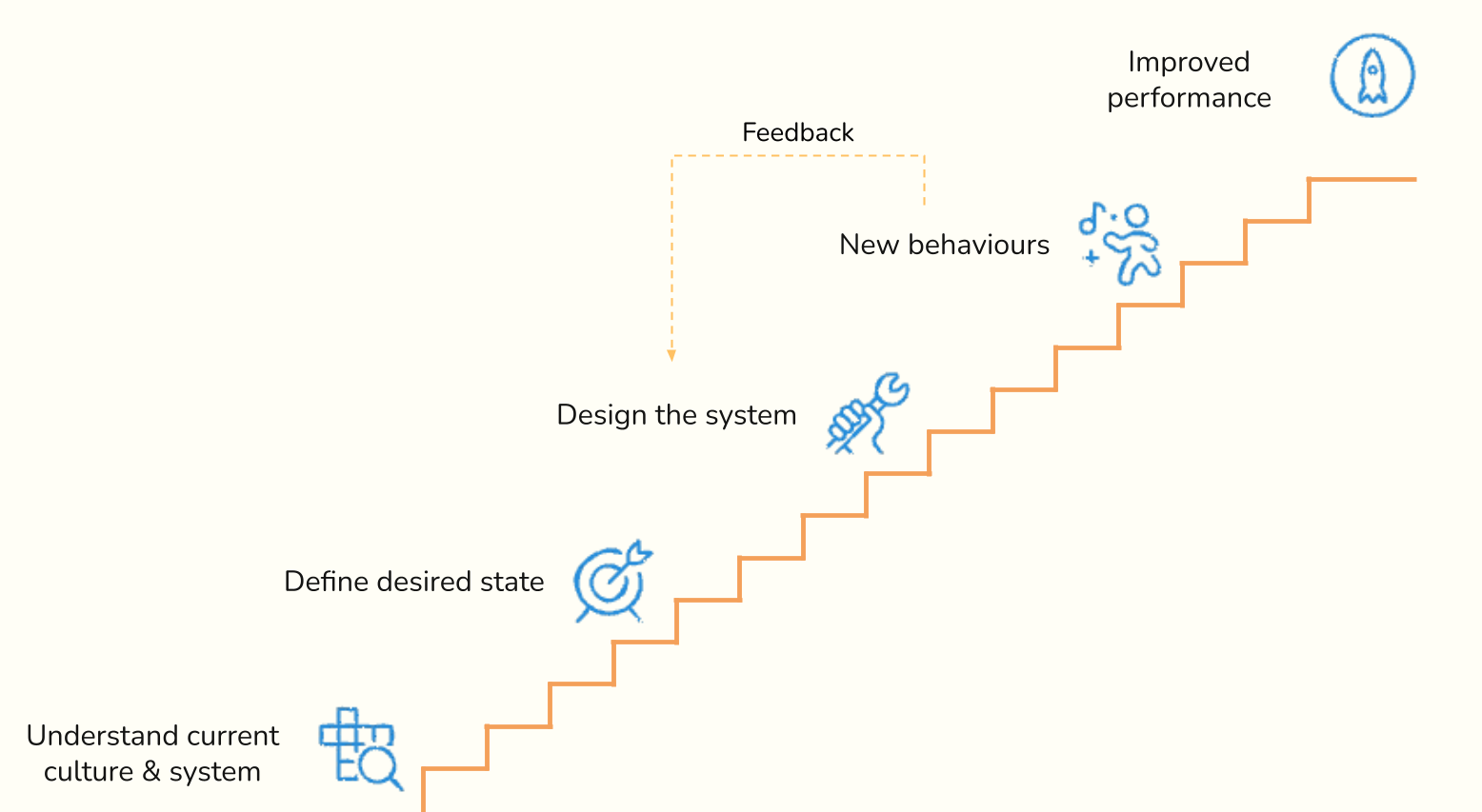
Shape Culture Intentionally ©ProSocia
Steps to Shape and Nurture Culture
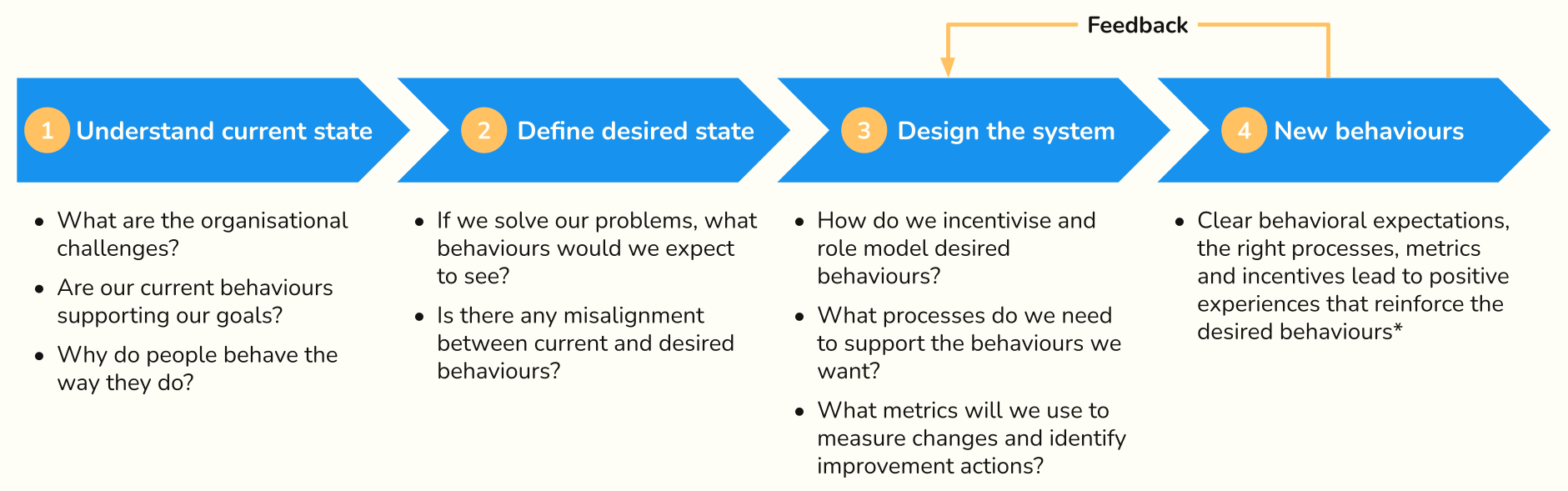
Steps to Shape and Nurture Culture ©ProSocia
*Read more about what drives behaviour and how to shape and measure culture: Shaping culture | Measuring culture
Understand current behaviours and the reasons behind them
Start with the strategic goals and the structures, metrics, processes and incentives that shape behaviour today.
This is the step most organisations skip because it takes effort. Without understanding why people behave as they do, we can’t change those behaviours.
Questions to ask
- What challenges and opportunities do we have in our organisation?
- Are our current behaviours supporting our strategic goals?
- Why do people behave the way they do?
How
- Observe how teams work.
- Have teams and leaders self-assess their interactions and actions.
- Run anonymous surveys that provide qualitative and quantitative data.
- Interview people about their perceptions and experiences.
- At team level, review insights from retrospectives and similar team reflection sessions, only where teams choose to share them and confidentiality is protected if used outside of teams.
- Use several measures rather than relying on one, so no single metric gets corrupted (see more on risks and mitigations).
Define the behaviours we want
While step 1 makes the current culture visible, this step makes the desired culture tangible. We translate values and aspirations into specific, observable behaviours. This creates a shared understanding of what is expected.
Questions to ask
- Which behaviours are critical to achieving our strategic goals?
- If we became the organisation we want to be, what would our behaviours look like?
How
- Describe each behaviour in specific, observable terms so everyone shares the same understanding of what good looks like.
- Define the specific behaviours leaders need to role-model, given their outsized influence on culture.
- Comparing current and desired behaviours shows the gap and what is needed to close it.
Design the system
Establish how to shape, reinforce and support the desired behaviours.
The aim is to build a preventative system. Rather than waiting for the culture to become toxic before we do anything to avoid the cost and effort of dealing with the results of a poorly designed system.
Questions to ask
- Which incentives, role modelling and processes will support those behaviours?
- How will we embed these behaviours in every leader’s, team’s and individual’s goals, development conversations and career progression?
- Which metrics will show whether behaviours are moving in the right direction, and why?
How
- Based on what we’ve learned about why people behave the way they do, we design small experiments: changes we believe will encourage the desired behaviours.
- We then observe and measure how people respond and adjust based on what we learn. Fast feedback loops allow the organisation to learn and adapt continuously.
- Define what to measure, why and how. Pair metrics that show whether behaviours are changing with insights that explain why. Numbers tell us what is happening; conversations, open-ended survey questions and team reflections tell us why. For example, if fewer issues are being raised, is it because problems are being solved or because people no longer feel safe speaking up? The same number can point to opposite actions, and only the why tells us what to change in the system next (read more on measuring culture).
See new behaviours emerge: reinforce what works, adapt what doesn’t
When expectations are clear, processes encourage the desired behaviours and people feel supported, they start to have positive experiences. When these experiences are consistent, new behaviours emerge.
Questions to ask
- What is and isn’t working, and why?
How
- For example, collaboration improves, decisions get easier and people feel safer raising issues because they see them resolved quickly. These experiences reinforce the new behaviours.
- Over time, this leads to improved performance.
- Regular feedback from these metrics flows back into step 3, so the system keeps evolving based on what works and what doesn’t.
Think Big, Start Small, Learn Fast
This might feel like a lot. The good news is that we don’t need to do everything at once to see positive change. We can start with one team or one challenge that matters to our strategy and work through the steps on a smaller scale:
Understand: hold a few conversations or run a short survey to learn why people behave the way they do.
Define: agree on two or three behaviours that would make the biggest difference and describe what they look like day to day.
Act: choose one small change to the system that is possible now, given the effort and time it would take, and see how people respond such as how decisions are made or how issues are raised (Snowden, 2022).
Each small cycle builds momentum, shows early results and gives us the insights to scale what works.
Even the strongest cultures don’t sustain themselves. Like software, they need continuous maintenance. Just as engineering teams manage technical debt, organisations need to manage cultural debt: the gap between the behaviours they say they value and the behaviours their system actually rewards. Every unaddressed inconsistency accrues interest in the form of eroded trust and growing cynicism. I’ve seen this countless times. For example I worked with a leader who kept emphasising how much he valued his people and wanted to empower them but kept micro-managing them and talking over them. The team quickly developed a high level of cynicism and for a new leader to build trust with them was very difficult. The more debt we accrue, the harder it becomes.
If we aren't actively shaping, measuring and reinforcing our culture, it will still evolve, but perhaps not in the direction we want.
Conclusion
In the age of AI, culture is more important than ever. It determines how quickly organisations can learn, adapt and turn new technology into real value. Technology alone delivers no value without a strong cultural foundation. The hardest part of AI isn’t technical implementation: it’s creating and nurturing the culture necessary for success. That is also where the biggest return lies. Organisations can’t realise ROI by simply laying AI on top of what already exists. By getting the culture right, however, they can turn AI investment into lasting value for the organisation, its people and its customers.
Culture is how we act. It’s our behaviour, which is largely shaped by the system people work in. Positive organisational change therefore lives or dies by the ability to create the right conditions for people to change their behaviours. This article has explored three principles for creating those conditions: understanding why people behave the way they do, making culture everyone’s responsibility and making culture tangible. Together, they turn culture from a wish list into a deliberate part of the organisation’s strategy.
A four-step method puts this into practice: (1) understand current behaviours and the reasons behind them; (2) define the behaviours we want; (3) design the system to support them; and (4) see new behaviours emerge through consistent positive experiences, then reinforce what works and adapt what doesn’t. We don’t need to do everything at once. Think big, start small and learn fast: choose one team or one challenge that matters to our strategy, run small experiments, gather feedback quickly and scale what works. Since culture is emergent, small cycles of experimenting and learning tend to work better than a fixed, top-down plan.
Culture is never finished. It will keep evolving whether it is shaped intentionally or left to chance. The organisations that capture lasting value from AI will be the ones that intentionally shape behaviours guided by the three principles. That way, their culture evolves in the direction they need to succeed, not just tomorrow but well into the future.
References
Hanna, D.P.: ‘Designing organizations for high performance’, 1988, Reading, MA: Addison-Wesley.
Hunter, J.: ‘A bad system will beat a good person every time’, 26 February 2015, The W. Edwards Deming Institute. Available at: https://deming.org/a-bad-system-will-beat-a-good-person-every-time/ (Accessed: 14 October 2026).
Rumelt, R.P.: ‘Good strategy/bad strategy: the difference and why it matters’, 2011, New York: Crown Business.
Schein, E.H. and Schein, P.A.: ‘Organizational culture and leadership’, 5th edn, 2017, Hoboken, NJ: Wiley.
Snowden, D.: ‘Complex acts of knowing: paradox and descriptive self-awareness’, Journal of Knowledge Management, 6(2), 2002. Available at: https://doi.org/10.1108/13673270210424639 (Accessed: 14 October 2026).
Snowden, D.: ‘Estuarine mapping first edition’, 7 October 2022, The Cynefin Co. Available at: https://thecynefin.co/estuarine-mapping/ (Accessed: 14 October 2026).
Tinkoff, D., Van der Veken, L. and Chui, M.: ‘The state of AI in 2026: On the road to ROI’, August 2026, McKinsey & Company. Available at: https://www.mckinsey.com/~/media/mckinsey/business%20functions/quantumblack/our%20insights/the%20state%20of%20ai/the-state-of-ai-in-2026-on-the-road-to-roi-aug-2026.pdf (Accessed: 15 October 2026).
Weeks, R.: ‘Organisational culture: a contemporary management perspective’, Acta Commercii, 10(1), 2010, pp. 43–58. Available at: https://doi.org/10.4102/ac.v10i1.112 (Accessed: 14 October 2026).
Weick, K.E.: ‘Sensemaking in organizations’, 1995, Thousand Oaks, CA: Sage.