Moving Beyond Projects: A Practical Guide to Rethinking Your Funding Model
Only around 35% of projects in organisations are considered successful (Harvard Business Review, 2023). Imagine if that success rate was closer to 100%.
This immense potential begs the question: why are more companies not rethinking their approach to projects?
As with many other organisational challenges, the issue lies in the prevalent focus on symptom management instead of addressing the root causes.
This article examines why the traditional project funding model causes so many project failures and provides a step by step guide to transition your organisation from project to team funding to deliver projects and products more successfully. It draws on extensive research combined with our experience helping organisations designing and implementing effective operating models.
While project based funding has its place given the right conditions, the problem arises when organisations rely on it too heavily and exclusively.
The Problem with Projects
Let us start with a simple scenario to bring this to life. Imagine this: An organisation delivers a high volume of different digital services every year. Technology is treated as a cost centre and funded through projects. Projects are funded based on a fixed set of requirements, scope and deliverables. The services are built with the confidence that everything is known upfront. The project team is given requirements they need to deliver instead of identifying customer needs. Once the project team tasked with building a service is done it is swiftly dismantled leaving it unclear who will be responsible for maintaining and improving the service over time.
In many cases, projects miss agreed timelines, typically resulting in either delivery failure or increased budget and effort. When the service needs repair in the future there is no team that owns it and has the in-depth knowledge of how it functions so it often becomes a patch solution. A common approach is to pull in a member of the original project team to do the work, but as they have been reassigned to another project team this often delays both the repair work and their new project. The issues cascade.
The fixed requirements, scope, deliverables and timelines of the traditional project-based approach limit an organisation’s ability to adapt to changes and continuously deliver value. When the budget is locked in for the financial year it is often impossible to adjust the funding despite changing priorities, markets and new information.
Cost estimates of the project based approach are often inaccurate because they are determined before the full scope of the project can be evaluated and updating the plans requires a time-consuming change control process.
Leadership watches from the shore, baffled by the ongoing problems with the services and the poor performance of the teams. This is unfortunately an all too common reality of many organisations today.
Common Challenges of the Project Based Funding Model
A project based funding model often creates several recurring challenges for organisations:
Slow start-up times: the establishment of a new team for every project is time consuming and costly
Slow delivery of value to the business and customers: slow start-up times mean that it takes longer for the team to start delivering value
Less value delivered: missed opportunities to deliver greater value when teams learn new information and when there are changes in market and/or business priorities
Over reliance on contractors and vendors drive up costs, reduce knowledge retention and increase technical debt
High cost of delivery and changes:
The overhead of setting up a project team often costs more to deliver the same piece of work under a project model than it would under a product model.
It is difficult and time-consuming to reallocate funding to new opportunities or needs due to fixed scope
High technical debt due to lack of ownership and accountability of the services long term lead to little focus on maintenance. i.e. project teams are often incentivised to deliver functionality quickly and cheaply, which sacrifices maintainability of the code.
Low engagement: teams are unstable, have little autonomy to make decisions, little ownership of work and are not accountable for the long term impact which lead to reduced motivation amongst team members
Knowledge lost due to the temporary nature of project teams the knowledge is often lost once the project ends
Limited agility, accountability and learning: it is often unclear why projects fail, there is no mechanism for continuous learning and improving to avoid making the same mistakes and ability to adapt to new information
Short term thinking: no continued ownership and strategy for maintenance and improvement without establishing a new project
Poor team performance: teams never exist long enough to learn how to effectively collaborate to enter the high performance stage (Tuckman, 1997)
Conditions for Successful Project Funding
Project teams can be successful if the following conditions apply:
The scope is known definitively in advance and will not be subject to change. As such, they know exactly what work they will be doing and the benefits of it so they can accurately predict costs and guarantee success measures are met.
The solution is well defined and understood.
The context is static (it is not subject to any changes).
They can be flexible with how the budget is spent.
There are no startup costs when establishing a new team or it is included in the budget.
Top down governance such as steer-co/approval boards are best suited to make most of the decisions about the work (not the project team)
However, these conditions remain the exception in most organisations.
Fix the Root Cause Not the Symptoms
The common problems organisations focus on are symptoms of an inadequate funding model such as: high costs and slow delivery.
Consequently, the way an organisation allocates funding directly shapes its ability to deliver customer and business value.
The heavy reliance on the project based funding model forces organisations into a constant reactive firefighting mode, which discourages long-term strategic thinking and leads to loss of motivation for everyone.
Difference between Project and Team Funding
| Aspect | Funding Projects | Funding Teams |
|---|---|---|
| Success criteria |
|
|
| Fund allocation |
|
|
| Governance |
|
|
| Team structure |
|
|
| Customer focus |
|
|
| Knowledge / learning |
|
|
| Risk |
|
|
| Duration |
|
|
| Flexibility |
|
|
| Value delivery |
|
|
| Engagement |
|
|
| Strategic outlook |
|
|
| Team performance |
|
|
| Technical debt |
|
|
|
|
|
From Project to Teams Based Funding
So what can organisations do instead of funding projects? They can fund teams.
The following principles will help guide your transition to funding teams.
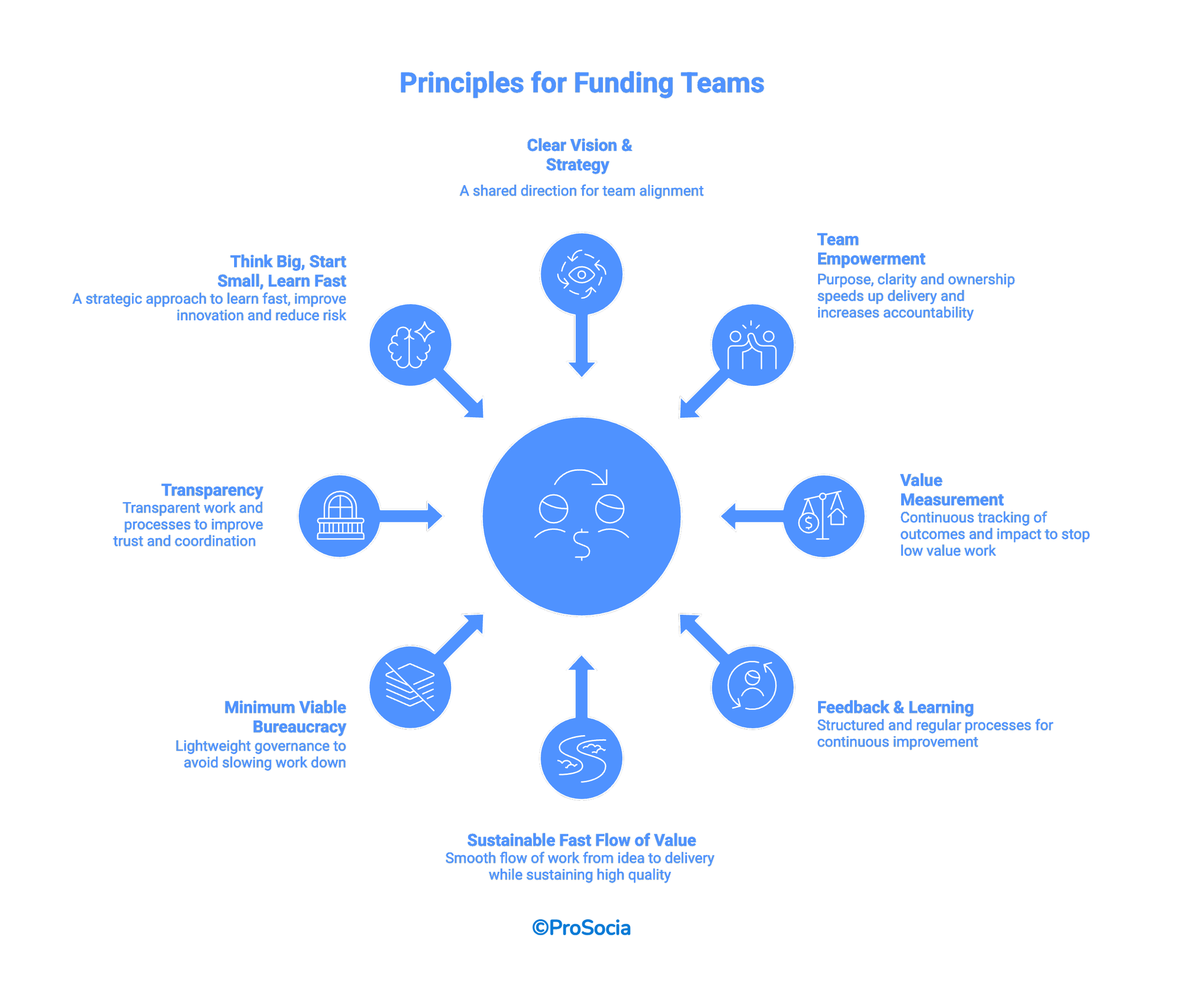
Ensure you have a clearly defined organisational vision, strategy & goals
This gives everyone a shared north star, teams can align, understand why their work matters and how success is defined.
It also provides a basis for prioritisation, trade-offs, and saying no to work that does not advance the strategy.
Empower teams & ensure the purpose of each team is clear
Each team should know the customer or stakeholder they serve, the value they create, and the outcomes they own.
With clear purpose and decision rights, teams can act autonomously instead of waiting for approvals, which speeds up delivery and increases accountability.
Measure value continuously, not just cost
Track the outcomes and impact of work rather than focusing solely on budget and utilisation.
Continuous value measurement helps you stop low-value work early and double down on what is working.
Embed feedback & learning cycles
Establish structured, regular processes to inspect and adapt work and to improve team work
Optimise for sustainable fast flow of value
Design teams and processes so work can move smoothly from idea to delivery without frequent handoffs and delays.
Ensure high quality, manage work in progress and ensure teams can maintain this pace over time.
Create a minimum viable bureaucracy
Put in just enough governance, policies and approvals to be safe and compliant but not so much that it slows decision making and innovation down.
Standardise where it truly helps and keep the rest lightweight and adaptable.
Make processes and work transparent
Use visual boards, shared backlogs and clear workflows so everyone can see priorities, status, blockers and ownership.
Transparency reduces duplication, surfaces dependencies early and builds trust between teams and leadership.
Think Big, Start Small, Learn Fast (Mui, 2014)
Think Big ensures you stay connected to the long-term vision and strategic impact.
Start Small means using experiments and pilots to reduce risk and get early feedback.
Learn Fast means regularly inspecting progress and results and adapting your approach based on the evidence.
Step by Step Guide
Transitioning to a teams funding model has operational as well as cultural implications as it requires rethinking success measures, structure, reporting, collaboration, governance and investment.
The below process can be adapted to your context. Your organisation might already have some of the elements in place. Focus on adapting your existing processes and gradually transition while you build the new funding model capability.
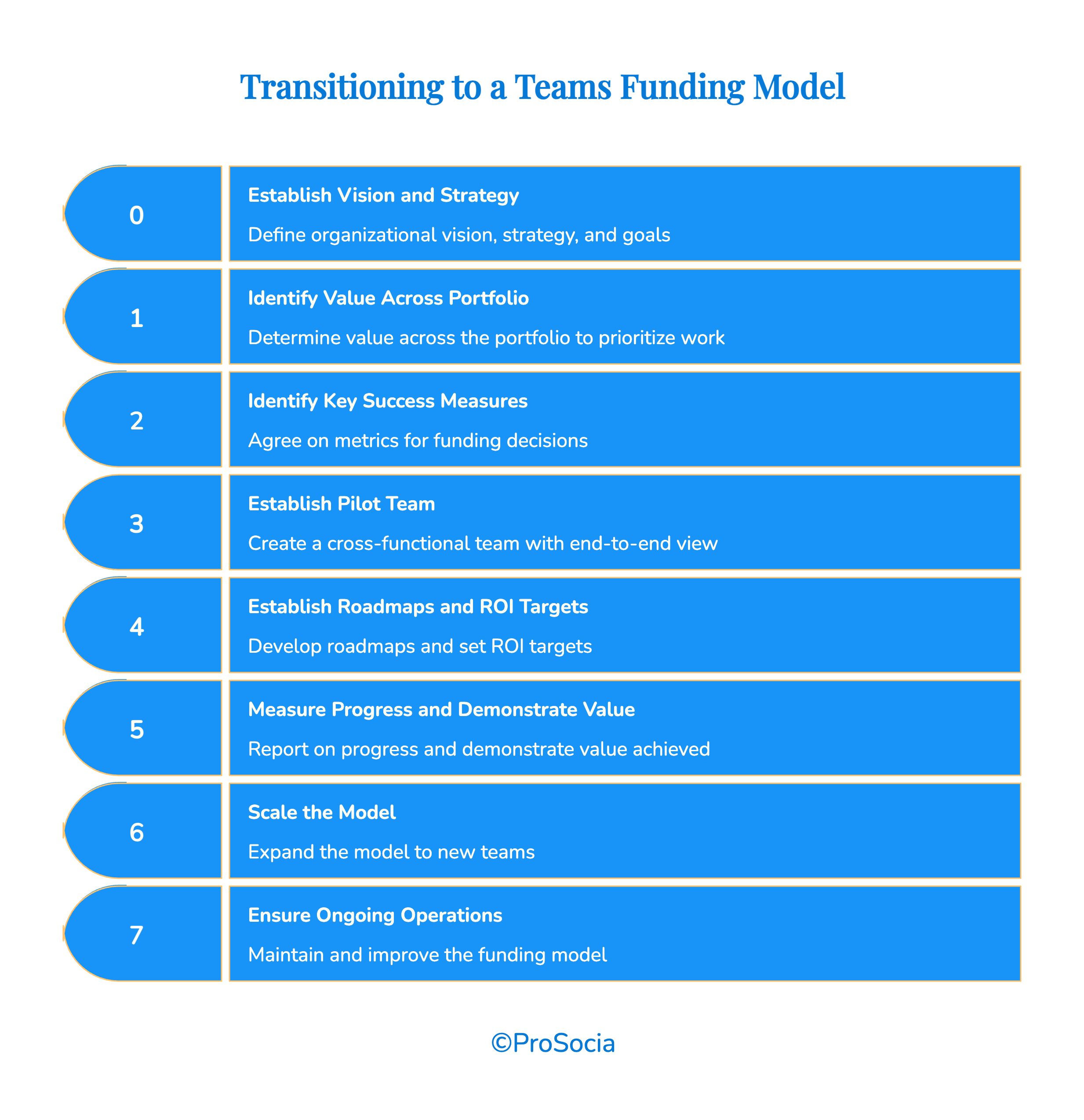
Step 0: Establish organisational vision, strategy and goals
If you do not already have these in place it is critical to establish that to ensure direction and team alignment. Without them it is like navigating a boat without a compass.
Step 1: Identify value across the portfolio
Identify what value means to your organisation across the portfolio to be able to prioritise work accordingly.
This often involves the enablement of a Value Realisation Office (Smart, p. 202) investment/priorisation committee/group
Step 2: Identify key success measures
Agree on what leading (predictive, early signals) and lagging metrics (retrospective, results measures) provide insight into funding decisions.
Example of leading indicators:
Cycle time (speed from idea to delivery)
Capacity (team bandwidth for new work)
OKRs/KPIs (progress toward strategic goals)
Team engagement (surveys, observations, conversations)
Example of lagging indicators
ROI (return on investment)
Quality metrics (bugs, defect rates post-release, speed etc.)
Stakeholder/customer satisfaction (surveys, observations)
Consider your desired outcomes (what behaviour changes do you expect to see) and impact (what benefit to the organisation / society / the world) not just outputs (deliverables).
Step 3: Establish a pilot team that is empowered and encouraged to take an end-to-end view of the service or product
Ensure that the team’s roadmap is aligned to strategy (customer and organisational value)
That it is not a one-off project but that there are opportunities for ongoing discovery and delivery work.
It is a cross-functional team with the necessary skills and consequential* work.
There are minimal dependencies on other areas.
Step 4: Establish roadmaps & ROI targets
The pilot team should build a roadmap using customer/stakeholder insights
Empower teams to manage their own budgets and set their ROI target
The team establishes how it wants to demonstrate ROI
Leadership determines whether that is an acceptable ROI
Step 5: Measure progress & demonstrate value achieved for the pilot team
Report on both leading and lagging indicators
Demonstrate the impacts of the new funding model and compare the costs to the previous model
By assessing the value delivered on an iterative basis it creates a greater ongoing visibility of the financial performance that helps inform decisions
Step 6: Scale the model
Gather and analyse learnings from the pilot team to inform your scaling strategy
Decide on your scaling strategy. Do you gradually roll out the model to new teams or do it all at once? Or roll out to individual departments (or value streams)? Your choice depends on your context.
Create a plan for how to empower and support the teams
Monitor the following to prevent regression:
Do leaders support teams rather than directing them?
Do teams have clear areas of responsibility?
Are they being constantly interrupted to work on things outside of their area of responsibility?
Is there work that does not have a home anymore?
Agree upon iterative funding cycle and align it with the strategic planning cycle
When new problems arise assign them to teams with appropriate skills to solve them
Step 7: Ensure ongoing operations & continual improvement
Ensure that strategic plans, roadmaps and goals are reviewed, refined and aligned on a regular basis (i.e. quarterly) to adapt to changing needs and opportunities
Align the funding cycle with the planning cycle to allocate funds to the highest priorities.
A well functioning prioritisation mechanism eliminates the need to fight over resources as it is clear to everyone what the highest priorities of the company are
Conclusion
A project based funding model often leads to short-term thinking as teams optimise for getting individual projects approved and delivered rather than building long-term capabilities and sustainable services and products. Moreover, the model fragments efforts across many initiatives, making it harder to maintain a coherent strategic focus. Since funding is tied to projects rather than stable teams people are frequently reassigned, which disrupts continuity, disrupts knowledge accumulation and reduces accountability for outcomes. Handovers between projects can also increase coordination overhead and technical debt. Furthermore, decision making becomes slow and bureaucratic as each new project requires its own business case, approvals and reporting rather than relying on a consistent team investment approach.
As such, funding teams rather than relying solely on project based models is essential for long term organisational success. This approach enables companies to drive greater growth while reducing costs. It fosters innovation, continuous improvement, it improves engagement, the ability to adapt to change and it increases return of investment.
Changing the processes and structures is often the easiest part, the real challenge lies in shifting the mindset culture needed to make them successful.
Read more about how to effectively shape culture.
References & Further Reading
Harvard Business Review: How AI will Transform Project Management, 2023
J. Richard Hackman: Leading Teams, 2002, Harvard Business School Press
Bruce W Tuckman & Mary Ann C. Jensen: Stages of Small-Group Development Revisited 1977, Group and Organization Studies
Chunka Mui: Think Big, Start Small and Learn Fast: 8 Rules for Corporate Innovation, 2014, Wharton
Jonathan Smart: Sooner Safer Happier: Antipatterns and Patterns for Business Agility, 2020, IT Revolution Press